Buyer-side software is a tool that puts listing, recall, and days-on-lot facts into a negotiation the buyer does not have to sit in. The car buying process hasn't changed meaningfully in 50 years. You find a car and go to a dealership. You sit across a desk from someone whose job is to get the most margin from you, and you try to reach a fair price.
Car dealers have always had the advantage: more information, trained negotiators, and sales tactics. A dealer negotiates every day, while you buy a car once every few years. Technology is beginning to close that gap.
The Information Gap Is Closing
For most of the car industry's history, only dealers had the numbers that matter. Those numbers are the auction cost, the cost of days on the lot, real comparable sale prices, and how motivated other buyers are. Buyers had sticker prices and consumer sites funded by dealer advertising.
Buyer-side software changes the information gap:
- Machine learning models now read millions of real transaction records to estimate fair market value. A model built on sales is different from a KBB estimate.
- Our platform cross-references listings across CarGurus, Cars.com, and dealer sites simultaneously, tracking days-on-lot trends and flagging anomalies in seconds, not hours.
How does one buyer talk to more than one dealer?
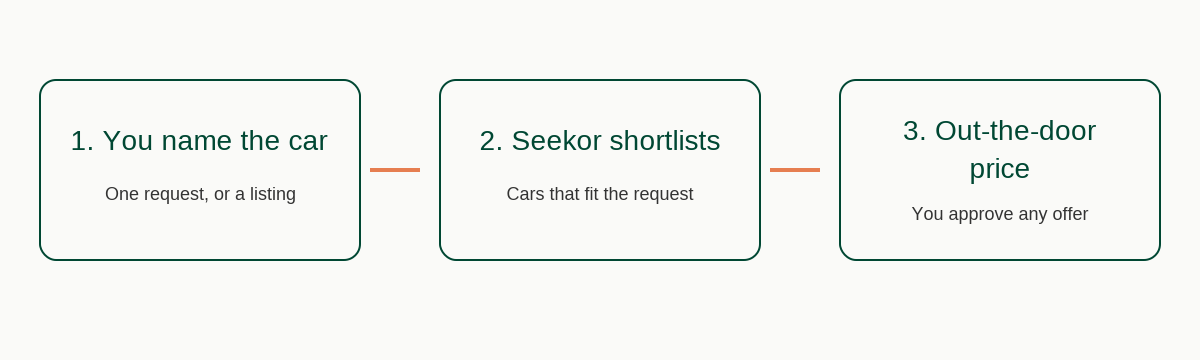
One buyer talks to more than one dealer by having the concierge ask them all for the out-the-door price at the same time. Dealers can talk to hundreds of buyers simultaneously, creating urgency and competition. Individual buyers can only negotiate with one dealer at a time. Seekor flips that one-dealer limit.
An intelligent concierge contacts 10, 20, or 50 dealers simultaneously on behalf of a single buyer — creating competition on the sell side. When multiple dealers know they're competing, the negotiation dynamic changes completely. The buyer goes from no leverage to significant leverage, without a single awkward phone call.
Real-Time Market Intelligence During Negotiations
A traditional car negotiation is static. A negotiation backed by live data changes as the facts come in. When a dealer replies with an out-the-door price, Seekor checks it against:
- Current comparable listings
- NHTSA recall data for that specific VIN
- Days-on-lot for that specific listing
- Recent transaction data in that market
"Your asking price is $4,200 above comparable listings and this vehicle has been on your lot 52 days" is a fundamentally different position than "I was hoping to pay a bit less."
The Recall Leverage Nobody Uses
NHTSA maintains a complete recall database searchable by VIN. Most buyers never check it before negotiating. Most dealers don't volunteer the information.
Seekor checks every VIN for open recalls automatically. When a car has an open recall, the recall becomes part of the negotiation. The dealer fixes it, or the price reflects it. An automatic VIN check finds facts a manual search usually misses.
The Personalization Layer
A human concierge can work 10–15 active deals before quality suffers. Our platform maintains personalized, context-aware communication with hundreds of clients simultaneously — remembering preferences, tracking progress, sending timely updates, answering questions instantly. Seekor clients get a dedicated concierge without paying for one person's full time.
What can software not replace in a car negotiation?
Software cannot replace the decision to buy, or the judgment that a deal has gone as far as it can. Technology is exceptional at information processing, pattern recognition, and high-volume communication. Software is less good at the human moments. Those moments are reading between the lines of a dealer reply, handling an unusual case, and judging when a deal has gone as far as it can.
The best technology-powered buying experiences combine automated intelligence with human oversight. Our platform handles the volume work. People step in when judgment is required. Seekor is built with that split.
The Broader Shift
Car buying is one of the last major consumer transactions that happens primarily on the seller's terms. Car buying on the seller's terms is changing. Dealers are not becoming friendlier to buyers. Buyers now have tools they did not have before.
The gap between a buyer who has the out-the-door facts and a buyer negotiating on feel shows up in the price. Technology is already changing car buying. The open question is whether the buyer has Seekor's help.
Where does buyer-side software stop?
Buyer-side software stops at the decision. The software can line up listings, check a VIN for an open recall, and record how many days a car has been listed. The software cannot tell you that you want the car, and it cannot sign the purchase.
Seekor is a buyer-side concierge, not a dealer, broker, or lender. Alex, the AI agent that calls dealers, identifies itself as an AI at the start of the call and cannot accept or bind an offer. You approve every number before it goes to a dealer. The purchase contract is between you and the dealer. Seekor does not arrange the loan and does not hold the car or your money.
A few limits are worth stating. If only one dealer has the car, software cannot invent a second seller. If the listing hides prior paintwork, a person still has to look at the car or an inspection report. If you want a car that has not been built yet, there is no used comparable to point at. The 1% fee is due only if you and the dealer reach a purchase agreement. If you do not buy, you do not pay that fee.
What does a dealer hear when the buyer is not on the call?
The dealer hears a request for the out-the-door price, not a monthly payment. The out-the-door price is the number to buy the car, before a loan. Seekor does not negotiate financing. The conversation stays on the car. Is it still for sale? What is the out-the-door figure? Is an open recall the dealer's to fix, or a reason to walk away?
You get the update. You say yes or no. If the number is not one you will pay, the instruction is to walk away. Walking away is the point of not being the person who has already sat in the car and wants the afternoon to end.