A car that holds value is a model whose used price stays closer to its original price than the typical luxury car. Not all premium vehicles depreciate equally. While the average luxury car loses 40–50% of its value in the first three years, a handful of models consistently beat that curve.
1. Porsche 911 — 3-Year Depreciation: ~15–18%
The 911 is in a category of its own. A well-specced 911 might lose 15–18% in three years. Certain configurations — GT3, Targa 4S, high-option Carrera S builds — have sold used for more than their original MSRP in strong markets. Multigenerational loyal ownership, careful supply management, and no budget substitute combine to create a floor under prices unlike any other vehicle.
Buying implication: Don't expect a steep discount. You're buying the car, not the depreciation arbitrage.
2. Porsche Cayenne GTS and Turbo — 3-Year Depreciation: ~22–28%
Porsche's brand halo, genuine performance, and SUV practicality in one package. The GTS and Turbo variants hold significantly better than the base Cayenne. Conservative production keeps supply tight.
Buying implication: A 2021–2022 Cayenne GTS with 25,000–40,000 miles is a strong buy right now — depreciation has hit but substantial life remains.
3. Land Rover Defender — 3-Year Depreciation: ~25–30%
The 2020 relaunch created one of the strongest value stories in premium SUVs. Genuine off-road capability, distinctive design, and supply that's never caught up with demand keeps resale values high. The 110 wheelbase and V8 variants hold particularly well.
Buying implication: A 2021–2022 Defender 110 with 20,000–35,000 miles hits the sweet spot. Reliability has improved significantly from early production.
4. Toyota Land Cruiser 300 Series — 3-Year Depreciation: ~20–25%
The Land Cruiser's value retention borders on legendary. The 300 Series immediately established strong residuals driven by its global reputation for longevity. Nothing else like it at this price point creates a floor under used prices.
Buying implication: Strong retention means limited used discount. Worth buying if the vehicle matches your needs — don't shop it expecting a bargain.
5. BMW M3 / M4 Competition — 3-Year Depreciation: ~28–33%
A generational leap in performance the market recognizes. The xDrive versions hold value particularly well. Constrained supply since launch plus performance credentials that compete with vehicles costing far more keeps prices elevated.
Buying implication: The 2021–2022 M3 Competition xDrive is one of the most compelling used performance sedan buys available. Expect 70–75% of original MSRP for a clean example.
What do the cars that hold value have in common?
They share tight supply, a job no cheaper car does as well, and buyers who keep wanting them used.
- Controlled supply
- Genuine capability that can't be replicated at a lower price point
- Loyal owner communities creating consistent secondary market demand
- No direct substitutes limiting downward price pressure
Where are the used deals that are not the cars that hold value?
They are the cars with the steeper drop, not the cars on the list above. German sedans (BMW 7 Series, Mercedes S-Class, Audi A8) lose 45–55% in three years — a $110,000 S-Class becomes a $55,000–65,000 used car while remaining every bit as luxurious. Large American luxury SUVs have softened back to normal depreciation. Italian performance cars like the Alfa Romeo Giulia Quadrifoglio offer extraordinary performance per dollar. The smart buyer knows which category they're in.
Where does the holding-value pattern stop?
The holding-value pattern stops at the specific car. A model that usually holds value can still be the wrong purchase if that VIN has an open recall, prior damage, very high miles, or a listing that has sat because buyers keep passing on it.
The figures on this page describe a pattern across models. They are not a quote for the car in front of you, and they are not a promise of what a dealer will accept. Mileage, options, accidents, and how long that exact car has been listed move the number. A car that holds value is often the car with less room to move. Do not shop a 911, a Defender, or a Land Cruiser expecting the discount you would see on a large luxury sedan.
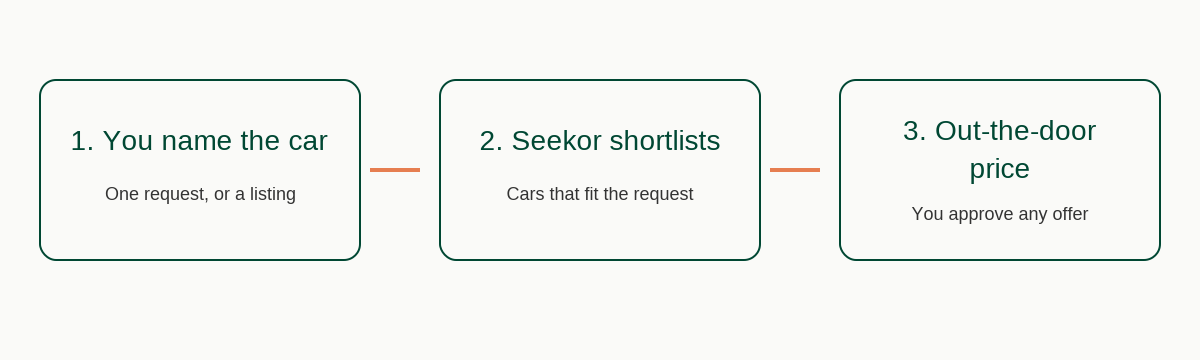
Seekor uses the pattern as the start of the conversation, not as a target price. We ask the dealer for the out-the-door price on that VIN. We check whether the car is still for sale and whether an open recall is unresolved. You approve any offer before it goes out. Seekor is not a dealer and does not sell you the car. You buy it from the dealer, or you do not buy it.
Edge cases come up often. A special-order color or a rare option can sit outside the usual range, in either direction. A car that is the only one for sale has no second dealer to compare. A car with a branded title is not the car this list is about. If you already signed a contract, this page is not a way to unwind it.
The fee, if you buy through Seekor, is 1% of the agreed purchase price, due only after you and the dealer reach that agreement. There is no retainer. If you walk away, you do not pay the fee.