A used-car dealer negotiation is a sale that happens in the dealer's building, on the dealer's numbers, and on the dealer's clock. Nobody likes it. Not the introverts who find confrontation physically uncomfortable. Not the busy professionals who resent spending a Saturday in a fluorescent-lit showroom. Not even people who consider themselves good negotiators — because they know the deck is stacked against them before they walk in the door.
If you've ever felt that knot in your stomach pulling into a dealership lot, you're not weak or unprepared. You're responding rationally to a system that was specifically designed to put you at a disadvantage.
Why do dealership negotiations feel so bad?
Dealership negotiations feel bad because the room is built to wear you down until you pay more than you planned. The discomfort is a feature, not a bug. The entire environment is engineered to produce a specific outcome: you paying more than you intended.
Here's what's working against you the moment you walk in:
- Home field advantage. You're in their building, in their process, surrounded by their people. The comfortable chairs, the coffee, and the long wait while the salesperson "checks with their manager" are part of the setup. The dealer's setup is built to wear down your resolve, so you want the visit to end.
- The information gap. The salesperson knows what they paid for the vehicle, what their minimum acceptable price is, and what your likely alternatives are. You know the sticker price and whatever you could find on Google. The information gap is not a fair fight.
- Time pressure. "This deal is only good today." "We have another buyer coming in this afternoon." "My manager can only hold this price until end of business." Those lines are not coincidences. Dealers use them as tactics. Artificial urgency is one of the most effective tools in a dealer's playbook.
- The four-square. Many dealers still use a technique called the four-square — a worksheet that simultaneously negotiates purchase price, trade-in value, monthly payment, and down payment. The goal is to keep you focused on one number (usually the monthly payment) while quietly adjusting others. The four-square is confusing by design.
- The finance office. You thought the negotiation ended when you shook hands on a price. The negotiation did not end there. The finance office is where dealers often make their highest margins — through add-on products at markups that would make a pharmaceutical company blush.
The Psychological Toll
Even for buyers who "win" — who walk out feeling like they got a fair deal — the process is exhausting. Hours of back-and-forth. The constant uncertainty about whether you're leaving money on the table. The performative theater of the manager consultation.
Studies on decision fatigue show that people make worse financial decisions as a negotiation drags on. Dealers know about decision fatigue. The longer a dealer can keep you in the building, the more likely you are to concede just to make it end.
Negotiation fatigue is why car buyers overpay. Car buyers are not bad negotiators. Car buyers are people run through a dealer system built to take more of their money.
What changes when you are not the one negotiating?
The dealer is no longer talking to a person who wants the afternoon to end. The moment you're no longer the one sitting across the desk, the entire dynamic changes.
When Seekor negotiates, the dealer is not talking to a buyer who wants the afternoon to end. The buyer is not in the room, so the dealer cannot use the buyer's attachment to one car. The dealer is talking to Seekor, which:
- Seekor has already identified 15 comparable vehicles across multiple dealers
- Seekor knows the days-on-lot for that listing
- Seekor has checked the VIN for open recalls and NHTSA complaints
- Seekor is in conversation with other dealers at the same time
- Seekor has no need to buy that specific car
- Seekor will walk away if the out-the-door price is wrong
A Seekor negotiation is a different conversation, because the dealer no longer has the buyer's urgency.
The Cost of Wanting It to Be Over
Buyers who dread the conversation tend to end it. That usually means accepting the number in front of them, and the add-ons that show up once they have already decided they want the car. The hours disappear into research, follow-ups, and second-guessing.
Seekor negotiates the purchase price. Seekor does not arrange financing or car loans. The purchase price is the conversation. What changes is who sits in it.
You Never Have to Do It Again
You can opt out of sitting in the dealer conversation entirely.
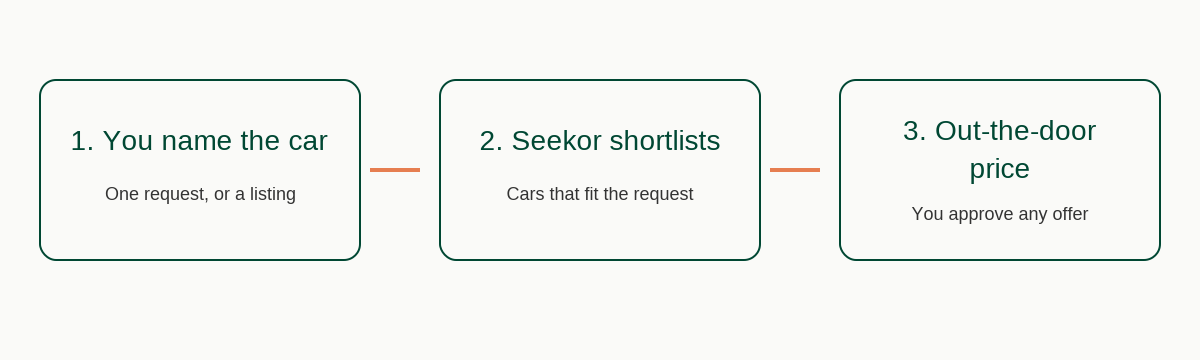
Seekor handles every interaction with the dealer. You tell us what you want. We find it, vet it, and negotiate it — via email, with data, while you do literally anything else. You receive updates by text. When we've reached the best available price, we bring it to you for a yes or no.
You never sit in a showroom. You never field a call from a salesperson. You never have to say "let me think about it" while your stomach churns. You get the car at a fair price. Seekor works only for you, from the first email to the final handshake.
The Seekor 1% fee, due when your deal closes, is not the cost of convenience. The 1% fee is the cost of never having to negotiate with a car dealer again — and coming out ahead financially in the process.
The Last Time
The average person buys a car every 4–6 years. That means most people have maybe 8–12 of these experiences in their lifetime. Each one is hours of stress, uncertainty, and a nagging feeling that they left money on the table.
You don't have to spend those hours that way. The tools exist to do this better. The only question is whether you use them.
What are the limits of having someone else negotiate?
A buyer-side concierge can run the dealer conversation. It cannot sign the purchase, and it cannot force a dealer to accept a number.
Seekor is not a dealer, broker, or lender. You contract with the dealer. Alex, the AI agent that places some calls, identifies itself as an AI and cannot bind an offer. You approve every offer before it goes out. Seekor does not arrange the loan, hold the car, or hold your money.
A few cases stay hard. If only one dealer has the car, there is no second seller to compare. If the car has an open recall, the conversation includes who fixes it. If you already signed a contract, Seekor is not a way to reopen it.
If the out-the-door price is not one you will pay, the result is walking away. The 1% fee is due only if you and the dealer reach a purchase agreement. If you do not buy, you do not pay it.