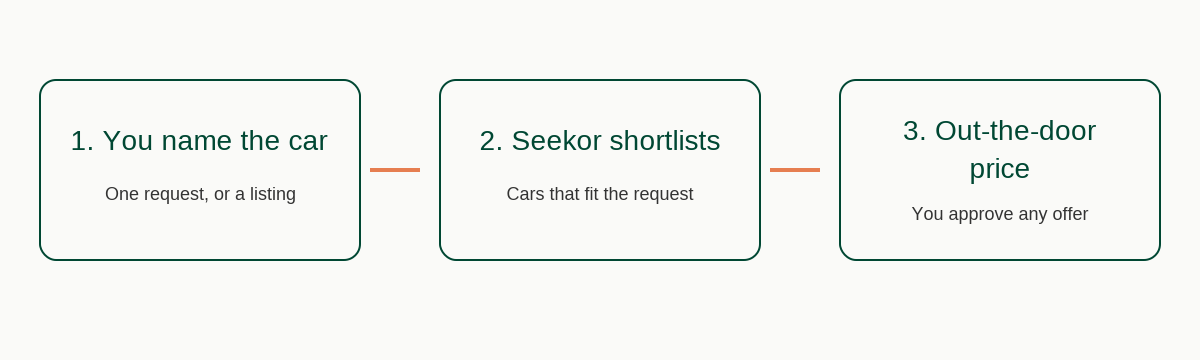
The cost of buying a car without a concierge is the hours you spend and the dealer information you do not have. Most people think hiring a car buying concierge is a luxury — something for people who have more money than time. The buyers who go it alone on a $70,000 or $90,000 car purchase are often missing the out-the-door number, not a nicer waiting room.
The Time Cost Nobody Calculates
A thorough premium used vehicle search involves:
- 8–15 hours of research
- 5–10 hours monitoring listings
- 3–6 hours vetting each serious candidate
- 4–8 hours of negotiation per deal attempt
- 2–4 hours on paperwork and logistics
Research, monitoring, vetting, negotiation, and paperwork hours add up before anyone has agreed on a car. The search time is the cost most buyers never put next to the purchase price.
The Information Disadvantage
You're negotiating against someone who does this every day. A dealer's finance manager has closed thousands of transactions. The finance manager knows the dealer's cost basis, how long the car has been on the lot, and the floor price. The finance manager also knows which buyers can be pushed further. You have a KBB estimate and whatever you read on Reddit.
Without access to actual dealer cost basis, real market transaction data, days-on-lot analytics, and comparable recent sales — you're negotiating blind on an $80,000 purchase.
The Anchoring Problem
Walk into a dealership and the first number you see is the dealer's asking price. The asking price is chosen to anchor what you think the car is worth. Dealers show you the sticker first, focus attention on monthly payments rather than total cost, and introduce add-ons after you're emotionally committed.
A professional negotiator starts from market data and dealer cost basis, working up to a fair price rather than down from an inflated ask.
What Going It Alone Usually Misses
A buyer working alone usually lacks days-on-lot, comparable listings, and someone whose only job is the buyer's side. Without those, it's easy to anchor on the asking price. It's also easy to accept extras once you're attached to the car. Seekor does not negotiate financing — the work is the vehicle and the out-the-door number, not the loan.
The Emotional Tax
Most people dread buying a car. The anxiety of not knowing if you're getting a fair deal. The guilt of wondering if you should have negotiated harder. The second-guessing that lasts months. Worry and second-guessing are real costs, even if they don't appear on a bank statement.
What does a buyer-side concierge cost?
Seekor costs 1% of the purchase price, and only when a deal closes. On a $75,000 vehicle, that's $750 — paid after you've already agreed to the deal.
Whether that fee is worth it depends on the car and on how much of the search you want to carry yourself. The hours you get back are part of the decision, not a guaranteed discount.
When does buying a car alone make sense?
Buying alone makes sense when you already have the car, the dealer, and an out-the-door number you trust. You may have bought several premium cars, trust a specific dealer, enjoy negotiating, and have real market data. If so, you can probably handle the purchase yourself. Few buyers fit all four.
For other buyers, a buyer-side concierge handles the out-the-door number on a large purchase, and the 1% fee is due only if you buy.
What does the 1% fee not cover?
The 1% fee is not a discount, not a warranty, and not financing. Seekor charges 1% of the purchase price you and the dealer agree, and only after that agreement. On a car you do not buy, there is no fee.
Seekor is not a dealer, broker, or lender. You contract with the dealer. We do not take the title, hold your money, or arrange the loan. Alex, the AI agent, can ask a dealer for the out-the-door price and must say it is an AI. Alex cannot bind you to an offer. You say yes or no.
Two limits matter. The hours listed above are a picture of a careful search, not a bill. And a concierge does not remove the decision. The only car that fits may have an open recall, prior damage, or a price the dealer will not move. In that case the result can be walking away. Walking away is a finished search.
Buying alone still fits if you are looking at one car, one dealer, and a written out-the-door number. Buying alone fits less well when you are comparing several cars and several dealers. In that case the real number does not exist until someone asks for it.
Here is an example of the information gap. You have three listings that look alike. Each dealer has a different fee stack once you ask for the out-the-door price. One car has an open recall. One car has been listed long enough that the dealer may have room, and one arrived this week.
None of those facts are on the window sticker. Someone has to ask, write the answer down, and put the three numbers next to each other. Asking the dealers is the work. The fee, if you then buy one of them through Seekor, is 1% of the price you and that dealer agree.