Buying the used car costs less than buying that same car new, because the first owner already paid the early depreciation. On a luxury car, that early drop is the main cost of being the first owner. The rest of this page shows where the comparison stops, including cars with no used supply yet.
Depreciation is the drop in a car's value after it is sold new. A new-car buyer often sees it about three years later. A car bought new for $85,000 can be worth $48,000 then. Nothing broke. Time passed and miles accumulated. Most buyers never put that drop next to the purchase price.
What does depreciation look like on a luxury car?
On a luxury car, depreciation is steepest in the first years, and the original owner pays that drop. New vehicles lose value faster than almost any other major purchase. The depreciation curve is steepest in the earliest years — which is exactly when the original owner is paying for the car.
Here's what the numbers look like for a typical luxury vehicle:
Year 1: A $90,000 BMW 5 Series loses roughly 15–20% of its value — $13,500 to $18,000 gone in 12 months, before the first scheduled service.
Year 3: The same car has lost 35–45% of its original value. That's $31,500 to $40,500 absorbed by the original owner.
Year 5: Total depreciation reaches 50–60%. That $90,000 car is now worth $36,000 to $45,000.
The original buyer paid for all of that. You don't have to.
The First-Year Effect
The sharpest drop in a vehicle's value happens the moment it's driven off the lot and registered. The instant a new car becomes a used car — technically the second it leaves the dealership — it loses 10–15% of its value.
This isn't a market inefficiency or a quirk of accounting. It reflects a real phenomenon: new cars carry a premium that evaporates immediately upon purchase. Buyers pay for the experience of being the first owner, the factory warranty, the untouched odometer. The moment those things exist in the past rather than the future, they're worth less.
For a $90,000 vehicle, that single moment of driving off the lot costs the buyer $9,000 to $13,500 in paper value — before they've even gotten home.
What are you paying for when you buy a new car?
When you buy a new car, you are paying for a warranty, an unworn car, the latest features, and the fact that you are first. Those things have real but depreciating value:
- The factory warranty. New vehicles come with manufacturer coverage — typically 4 years/50,000 miles bumper-to-bumper, longer for powertrain. Valuable, but modern third-party warranty products for used vehicles have become genuinely competitive at a fraction of the cost.
- Pristine condition. No previous owners, no unknown history, no wear patterns from other drivers. Real value — but a 2-year-old certified vehicle with 18,000 miles isn't meaningfully different in condition from a new one for most buyers.
- The latest technology. New model years bring updated infotainment and driver assistance features. Real value if the updates matter to you — but the 2022 version of most luxury vehicles has technology that remains genuinely excellent in 2026.
- The psychological satisfaction of new. Real and valid. But it's worth knowing the price — typically $15,000 to $30,000 on a premium vehicle over the first two to three years.
The Used Buyer's Advantage
When you buy a 2–3 year old version of the same vehicle, you get the same engine, interior, driving experience, and full remaining service life — at 35–45% less. On a $90,000 BMW 5 Series:
New: $90,000 purchase price. After 3 years: worth ~$52,000. Net cost of ownership: $38,000.
Used (same car, 3 years old, 28,000 miles): $52,000 purchase price. After 3 years of your ownership: worth ~$35,000. Net cost of ownership: $17,000.
Difference: The used buyer spent $21,000 less to own the same car for the same period of time.
Where Depreciation Hits Hardest
Not all vehicles depreciate at the same rate. The vehicles with the steepest curves — and therefore the best used value propositions — include:
- German luxury sedans (Mercedes S-Class, BMW 7 Series, Audi A8): 45–55% depreciation in three years. A $120,000 S-Class becomes a $55,000–65,000 used car while remaining fully luxurious.
- Large American luxury SUVs (Cadillac Escalade, Lincoln Navigator): Depreciation has returned to historical patterns of 35–45% over three years after the pandemic era.
- Italian luxury vehicles (Maserati Ghibli, Alfa Romeo Giulia): Depreciation of 50–60% in three years, creating extraordinary performance-per-dollar value on the used market.
The CPO Middle Ground
Certified Pre-Owned programs offer a middle path — used vehicles inspected and certified by the manufacturer, typically with extended warranty coverage approaching new car protection. CPO vehicles cost more than standard used but less than new.
For buyers uncomfortable with uncertainty, CPO is a reasonable compromise. For buyers who want maximum value and are comfortable with proper pre-purchase inspection and third-party warranty coverage, standard used offers better economics.
The Question Nobody Asks
When most people consider buying new versus used, they ask: "What's the price difference?" That's the wrong question. The right question is: "What is the total cost of ownership for each option over my expected holding period?"
When you factor depreciation into that calculation — which most buyers don't — the used car advantage becomes overwhelming in almost every scenario. The $40,000 you don't spend on depreciation doesn't disappear. It stays in your pocket, in your investments, working for you. Over a lifetime of car purchases, consistently buying used rather than new can represent hundreds of thousands of dollars in preserved wealth.
The Bottom Line
Buying new isn't irrational. The experience of a new car is real. The warranty protection is real. The satisfaction of being the first owner is real.
But those things have a price. On a $90,000 luxury vehicle, that price is roughly $15,000–20,000 in the first year alone, and $30,000–40,000 over three years.
Most buyers who think carefully about that number — really sit with it — decide the used car is the obvious choice. Not a compromise. The obvious choice.
Where does the used-versus-new comparison stop?
The comparison stops when the used car is not the same car. The dollar examples on this page are illustrations of depreciation, not a quote a dealer has offered you.
A used car can cost more to own if it needs tires, brakes, or an open recall the price does not reflect. A pre-purchase inspection is the limit on the claim that a two-year-old car is the new one with miles. Seekor does not arrange financing and does not sell an extended warranty. If you want the first year of a new model that has no used supply yet, there is no used car to compare.
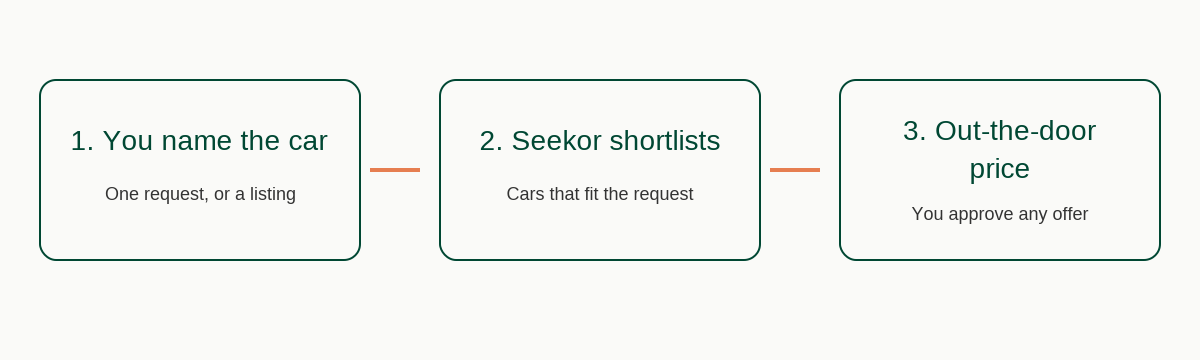
Seekor is a buyer-side concierge. If you buy, the fee is 1% of the agreed purchase price, due only after you and the dealer reach that agreement. If you do not buy, you do not pay the fee. You still decide whether the car, new or used, is the one you want.